

Torah Scrolls Destroyed in Attack on Civil Rights Era Synagogue
A deliberate fire at Beth Israel Congregation in Jackson recalls 1967 KKK violence amid rising national antisemitic trends.

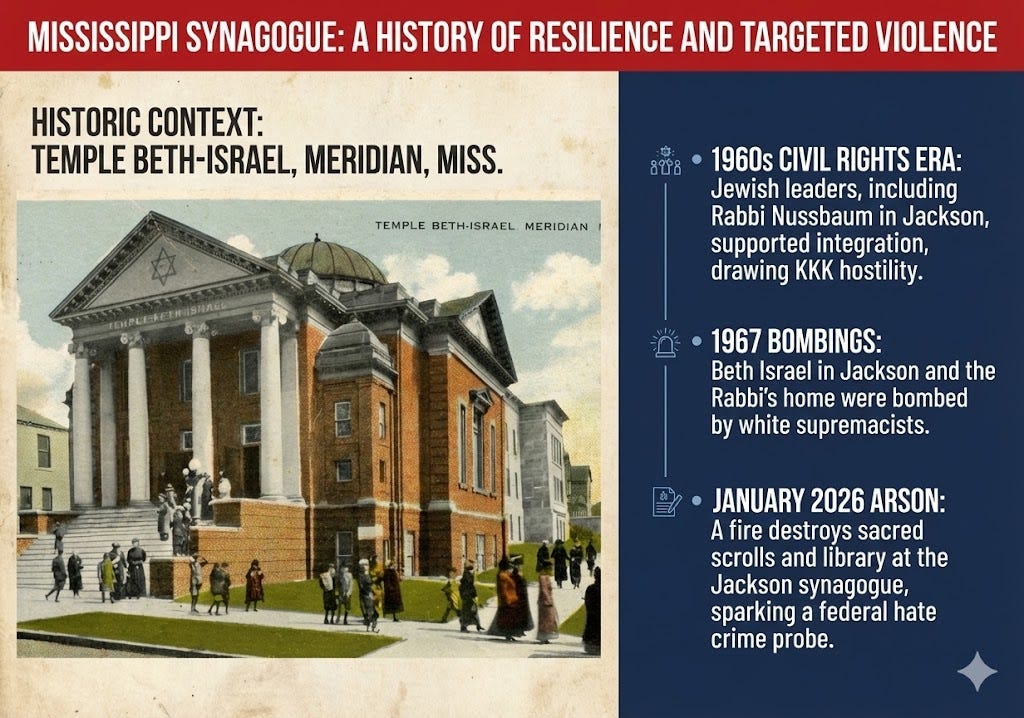
State and federal authorities have arrested an unnamed suspect for arson following a fire that severely damaged Beth Israel Congregation in Jackson, Mississippi, early Saturday, January 10, 2026. The blaze destroyed the synagogue’s library and two Torah scrolls. While no injuries occurred, the attack has drawn sharp parallels to a 1967 Ku Klux Klan bombing of the same institution. Jackson Mayor John Horhn condemned the act as “antisemitism” and “terror.” This incident occurs as the Anti-Defamation League reports record-breaking numbers of antisemitic incidents across the United States. Federal agents are currently investigating potential hate crime charges.
Yes, a suspect is in custody after admitting to setting the fire that devastated parts of Beth Israel Congregation this weekend. Investigators confirmed that the fire, which started in the library around 3:00 a.m. Saturday, was an act of arson. The suspect was arrested at a local hospital while seeking treatment for burns. This attack destroyed sacred texts and damaged the administrative wing of the only synagogue in Jackson, an institution with a history of being targeted by white supremacists.
This incident is not an isolated event but a specific legal and cultural inflection point. It forces federal prosecutors to determine if the arson meets the strict statutory definition of a hate crime under federal law. Furthermore, it connects modern antisemitic violence directly to the civil rights era, as this specific congregation was previously bombed by the KKK for supporting racial integration.
Why don’t we know the identity of the suspect?
We do not know the name of the suspect because he is currently hospitalized and has not yet been processed through the criminal justice system. Jackson Police and the FBI are adhering to strict pre-arraignment protocols. The suspect confessed to the burning of Beth Israel Congregation while receiving treatment for severe burns, but he has not physically stood before a judge or had a booking photo taken. Until he is medically cleared and formally charged, his identity remains a matter of non-public police record.
What are the facts of the Beth Israel arson?
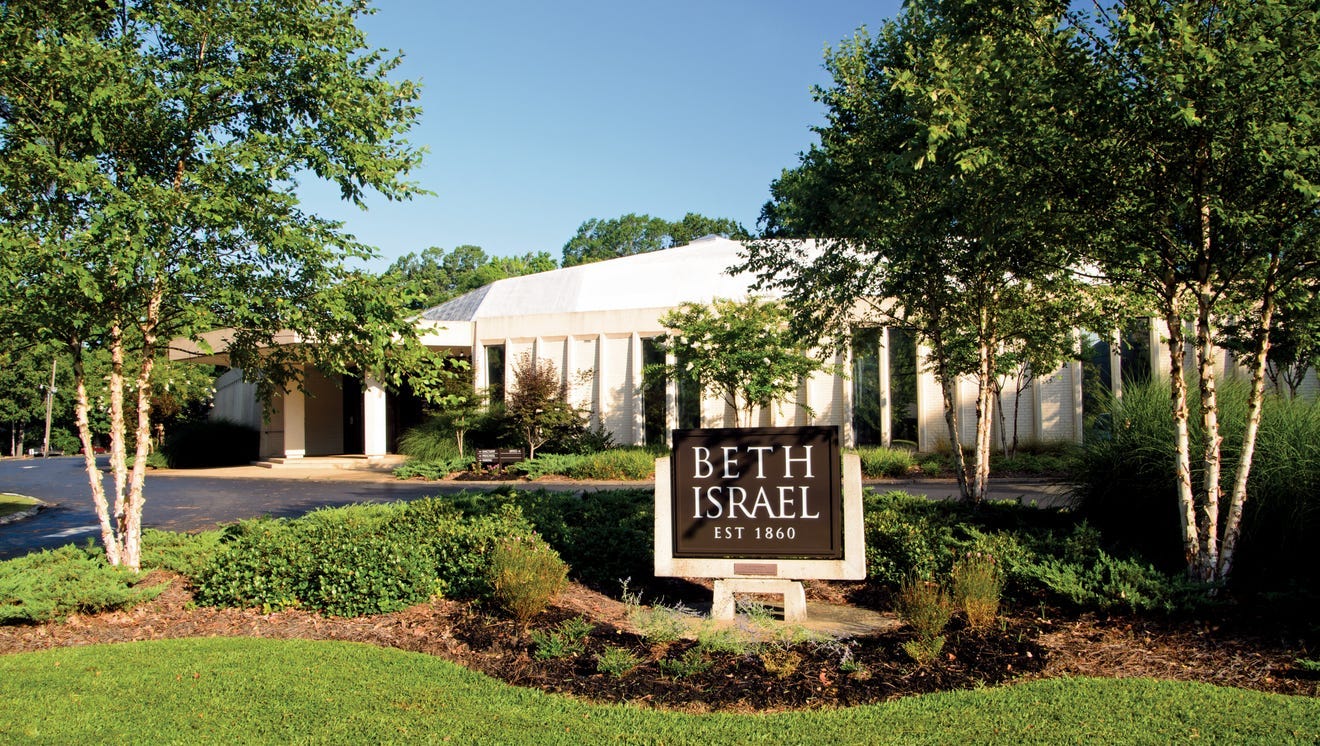
The Jackson Fire Department responded to a call at 5315 Old Canton Road shortly after 3:00 a.m. on Saturday, January 10. Firefighters found heavy flames concentrated in the library and administrative offices.
Damage: The library was “reduced to charred ruins.” Two Torah scrolls were destroyed. Five others sustained smoke damage.
Survival: A Holocaust-era Torah, protected by a glass case in the sanctuary, remained intact.
Casualties: The building was empty at the time. No congregants or staff were injured.
Suspect: Police arrested a man at a nearby hospital. He had sustained non-life-threatening burns and confessed to involvement in the fire. His name has not yet been released.
Mayor John Horhn stated unequivocally that the city views this as an act of terror. “Acts of antisemitism, racism, and religious hatred are attacks on Jackson as a whole,” Horhn said
.
The arson at Beth Israel is a direct attack on an institution that served as a rare sanctuary for civil rights activism in the Deep South. While investigators determine if the current suspect had political motives, the target itself is historically charged. This is the same congregation that the Ku Klux Klan bombed with dynamite in 1967 to stop its rabbi from supporting racial integration. For Jackson, this fire is a violent echo of the era when this specific building stood on the front lines of the battle against Jim Crow.
What is the History of Beth Israel?
Understanding the history of Beth Israel explains why federal agents moved so quickly to investigate this fire as a potential hate crime. This is not a random building; it is a monument to the alliance between Jewish and Black communities in Mississippi. Burning it down carries the same symbolic weight as burning a historic Black church.
Who was Rabbi Perry Nussbaum?
Rabbi Perry Nussbaum, who led Beth Israel from 1954 to 1973, was a “troublemaker” in the eyes of the Mississippi establishment. Arriving shortly after the Brown v. Board of Education decision, he refused to stay silent.
The Freedom Riders: When activists were arrested and sent to the notorious Parchman Penitentiary in 1961, Nussbaum drove 150 miles every week to visit them. He was often the only clergyman willing to minister to the prisoners—Jewish and non-Jewish alike—smuggling in supplies and writing letters to their terrified parents.
The Interracial Alliances: He helped found the “Committee of Concern,” an interfaith group dedicated to raising money to rebuild Black churches burned by white supremacists.
The Backlash: His activism angered the Klan and unsettled some of his own congregants, who feared violent retaliation.
What happened during the 1967 bombings?
The Klan eventually made good on their threats. The violence in 1967 was a coordinated effort to drive the Jewish community out of the civil rights fight.
The Synagogue Bombing: On September 18, 1967, Klansmen placed dynamite at the recessed door of the newly constructed Beth Israel building. The explosion destroyed the administrative wing and the library—the exact same sections destroyed by the arsonist this weekend.
The House Bombing: Two months later, on November 21, the Klan bombed Rabbi Nussbaum’s private residence while he and his wife were sleeping inside. Miraculously, they survived.
The Impact: Rather than silencing the community, the bombings shocked Jackson’s white moderates and galvanized local law enforcement to finally crack down on the Klan’s “Silver Dollar Group.”
What is the history of KKK violence against this synagogue?
Beth Israel has been a target of organized hate before. In 1967, the Ku Klux Klan bombed the synagogue’s newly constructed building on Old Canton Road.
The Motive: The attack was a direct retaliation against the congregation’s leader, Rabbi Perry Nussbaum. Nussbaum was a vocal supporter of the Civil Rights Movement and frequently hosted interracial clergy meetings.
The Escalation: Two months after the 1967 synagogue bombing, the Klan bombed Rabbi Nussbaum’s private residence.
The Outcome: These attacks galvanized the local community and law enforcement to crack down on Klan activity in Mississippi.
Current synagogue leaders note the parallel. “The echoes of history are deafening,” wrote one commentator, noting that the congregation’s stance on civil liberties has long made it a target.
Does this meet the legal definition of hate crimes?
This case will likely test the application of federal hate crime statutes. Arson is a state crime, generally punishable by prison time and fines. However, if federal prosecutors intervene, they must prove the suspect was motivated by bias against the victim’s religion.
State Charges: The suspect faces arson charges in Mississippi.
Federal Inquiry: The FBI and the Bureau of Alcohol, Tobacco, Firearms and Explosives (ATF) have joined the investigation.
Burden of Proof: Proving a hate crime requires evidence of intent beyond the act itself. The confession and the target (a house of worship) provide a strong baseline for federal charges under the Church Arson Prevention Act or the Matthew Shepard and James Byrd, Jr. Hate Crimes Prevention Act.
What do the data say about rising antisemitism?
The burning of Beth Israel aligns with a statistical surge in anti-Jewish hate crimes. The Anti-Defamation League (ADL) reported a historic spike in incidents in 2024 and 2025.
The Trend: Incidents of harassment, vandalism, and assault have increased over 300% since late 2023.
The Context: Southern states have seen a specific rise in white supremacist propaganda and targeted vandalism against religious minorities.
Security: Synagogues across the U.S. have been forced to increase private security spending, a burden that smaller congregations struggle to meet.
Analysis
The burning of a house of worship presents a unique intersection of criminal law and constitutional protection. While the act itself is arson—a straightforward property crime—the context elevates it to a civil rights violation. The First Amendment guarantees the free exercise of religion. When violence is used to intimidate a congregation, it functions as a “heckler’s veto” writ large, silencing religious expression through fear.
Prosecutors often hesitate to attach “hate crime” enhancements because they add a layer of complexity to the trial. In a standard arson case, the state must only prove the defendant set the fire. In a hate crime case, the state must prove why he set it. This requires diving into the defendant’s mind, his search history, and his past statements. However, in cases involving synagogues, the target itself often serves as 60% of the motive evidence. You do not accidentally burn down the only synagogue in Jackson, Mississippi.
The involvement of federal agencies here suggests the Department of Justice aims to send a deterrent message. Under the Church Arson Prevention Act of 1996, Congress made it a federal offense to intentionally deface, damage, or destroy any religious real property because of the religious character of that property. The penalties are severe, potentially doubling the prison sentence.
Finally, we must look at the specific history of this venue. The legal system allows for “contextual evidence.” If the defense argues this was random vandalism, the prosecution will likely introduce the history of the 1967 bombing not to prove the defendant was there (he wasn’t), but to prove that the target is a known symbol of Jewish resilience in the South. The choice of target is rarely accidental.
Works Cited
Elia-Shalev, Asaf. “Mississippi Synagogue Heavily Damaged in Arson.” Philadelphia Jewish Exponent, 12 Jan. 2026, www.jewishexponent.com/mississippi-synagogue-heavily-damaged-in-arson/.
Felton, Charles. “Suspect Arrested After Fire Damages Mississippi’s Largest Synagogue.” The Washington Post, 11 Jan. 2026, www.washingtonpost.com/nation/2026/01/11/mississippi-arson-arrest-synagogue-fire/.
Latino, Russ. “Arson at Beth Israel Synagogue Prompts Fear of Anti-Semitism in Mississippi.” Magnolia Tribune, 12 Jan. 2026, magnoliatribune.com/2026/01/12/arson-at-beth-israel-synagogue-prompts-fear-of-anti-semitism-in-mississippi/.
Wright, Kristin. “Arson Engulfs Mississippi Synagogue, a Congregation Once Bombed by Ku Klux Klan.” WCLK, 11 Jan. 2026, www.wclk.com/2026-01-11/arson-engulfs-mississippi-synagogue-a-congregation-once-bombed-by-ku-klux-klan.
Subscribe to ReligiousLiberty.TV: Stay informed on the prosecution of this case and other First Amendment issues. Subscribers receive immediate alerts on court filings and breaking news. Like, share, and subscribe to support objective legal journalism.
Disclaimers: This article was assisted by AI. This does not constitute legal advice. Readers are encouraged to talk to licensed attorneys about their particular situations.
The support that the community is giving to Temple Beth Israel hints at a broader story of the history of the Jewish community in Mississippi — and a whole lot of non-Jews who stand with them. Jewdicious explains. https://open.substack.com/pub/jewdicious/p/mississippi-burning-learning?r=fo39g&utm_campaign=post&utm_medium=web
Fascinating breakdown of the legal pathway from arson to hate crime prosecution. The parallels between 1967 and now are striking, especially since both attacks targeted the library and administrative wing specifically. This repetiton suggests a symbolic attack on the congregation's documented history and organizational capacity, not just physical destruction.